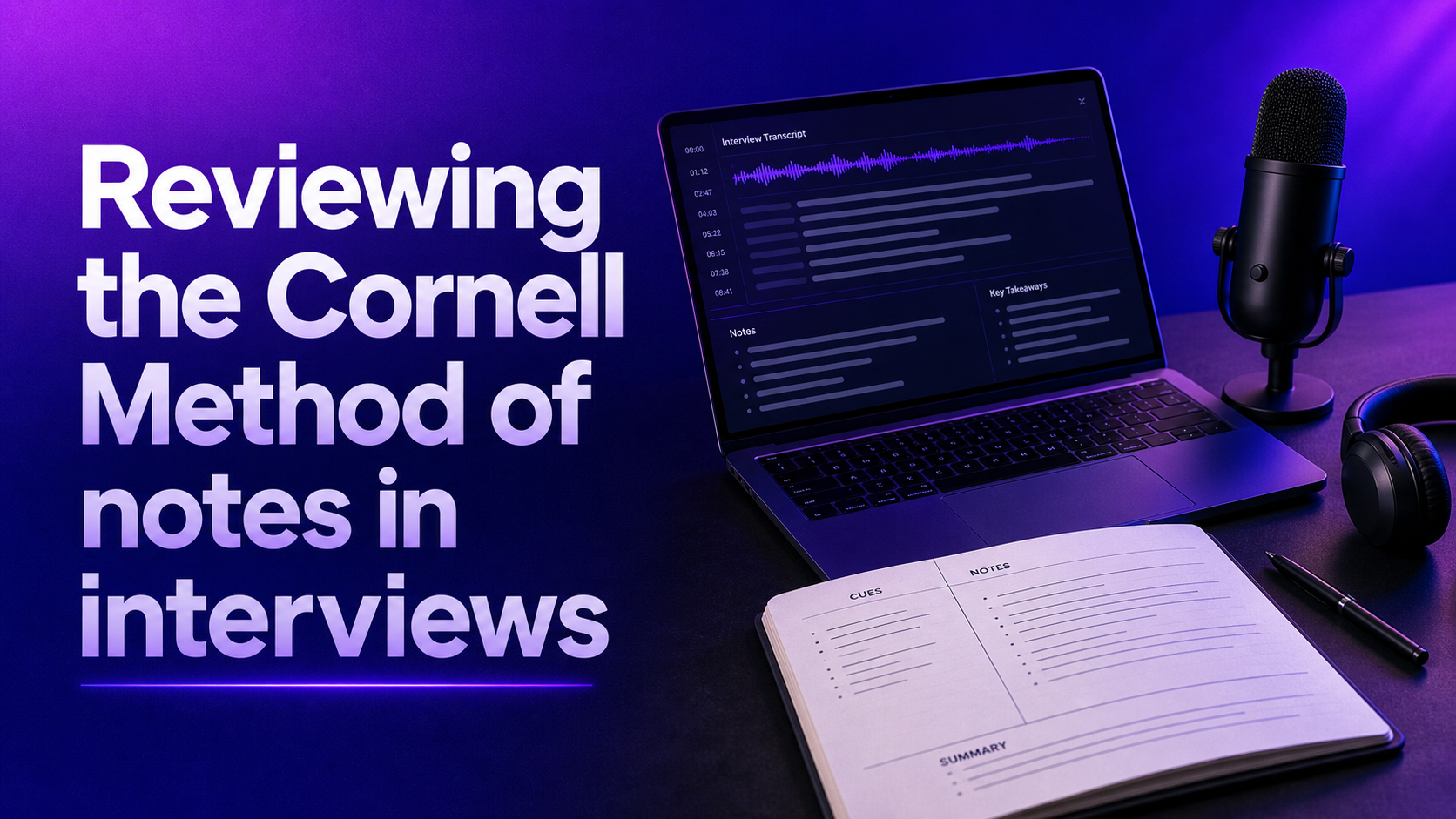


Transcribing video interviews is essential for turning valuable conversations into actionable hiring insights, improving accuracy, consistency, and collaboration across recruitment teams. Choosing the right transcription tool and integrating it into hiring workflows boosts efficiency and decision quality beyond simple text conversion.
A transcript is more than a written version of a video or audio interview. In recruitment, it becomes documentation, evidence, and a source of reusable insight.
The biggest benefit is focus. When recruiters know a video interview is being recorded and transcribed, they can spend more time listening, probing, and building rapport. That usually leads to better interviews. Instead of splitting attention between the candidate and a note-taking document, the recruiter can stay engaged and rely on the transcript afterward.
It also improves consistency. Hiring teams often struggle because each interviewer captures information differently. One person writes detailed observations, another writes two lines, and someone else forgets to submit feedback altogether. A transcript gives everyone a common source of truth. That makes it easier to compare candidates fairly and revisit the exact wording used during the interview.
There is also a clear compliance and risk angle. Compensation is a good example. If salary expectations come up, the transcript should clearly separate whether the recruiter mentioned a range or whether the candidate stated their expected or current salary. Without voice separation, that part of the conversation can easily become ambiguous.
Other practical gains include:
One point is non-negotiable: candidate consent. If you record a video interview in order to transcribe it later, the candidate should know that the conversation is being recorded, why it is being recorded, and how the file and transcript will be used. This should never be skipped or hidden in vague wording.
Many platforms can transcribe audio into text. Far fewer are truly suited to hiring workflows.
The first feature to evaluate is participant identification, often called diarization. In a recruitment interview, knowing who said each sentence is essential. This is especially important in panel interviews, salary discussions, notice period conversations, and any moment where a hiring decision may depend on nuance.
The second is accuracy. Automated transcription quality has improved dramatically, but it still varies depending on audio quality, internet stability, accent diversity, technical vocabulary, and overlapping speech. In ideal conditions, AI transcripts can be highly usable. In poor conditions, they can quickly become unreliable.
A strong hiring-focused transcription service should also offer:
It is also worth checking what the product is really optimized for. A tool that is excellent for subtitles, captions, and YouTube videos may not be the best option for confidential recruitment conversations. Likewise, an open-source speech-to-text model may deliver strong raw transcription, but if it requires technical setup, manual file handling, and no collaboration layer, it can create more effort than it saves.
For recruiters, usability matters. If the process requires saving out the session capture, converting the file format, uploading it into another tool, cleaning the transcript in a separate editor, and then copying observations into the ATS, that is too much friction for a repeated hiring workflow.
There is no single best tool for every team. The right choice depends on whether you need simple transcript generation, higher editing control, multilingual support, or a platform that fits directly into hiring operations.
Here is a practical comparison of the main categories and examples recruiters often consider, including setups that fit Riverside capture workflows:
| Tool / category | Best for | Strengths | Limitations for hiring |
|---|---|---|---|
| Otter | General meeting transcription | Fast transcript generation, live annotations, participant labels, straightforward sharing, free plan available | Better for meetings than structured hiring workflows, may need manual cleanup for interview nuance |
| Sonix | Fast file-based transcription | Good language coverage, easy upload, timestamps, translation and subtitle options | Strong as a transcription tool, but not designed around recruiting collaboration |
| Trint | Teams that edit transcripts heavily | Good editor, collaboration features, search, subtitle and content repurposing options | More content and media oriented than hiring oriented |
| Descript | Video and audio content workflows | Powerful editing, captions, subtitles, transcript-based media editing | Excellent for content creation, less ideal for confidential interview operations |
| Rev | Teams needing human review options | AI and human transcription, often useful when quality must be very strong | Human service costs more and slows turnaround |
| Whisper-based apps or open-source setups | Cost-sensitive or technical teams | Strong speech-to-text quality, flexible, sometimes free or low cost | Usually not recruiter-friendly, may require setup, manual file handling, and no built-in workflow |
| Liroad | Recruitment teams that want transcription inside the interview workflow | Designed for hiring, structured interview documentation, AI-assisted summaries, scorecards, analysis, less tool switching | Best fit when transcription is part of a broader recruitment process, not just a standalone transcript need |
A few practical takeaways matter more than feature lists.
If your main requirement is to upload a video file and receive a text transcript quickly, general-purpose AI apps can perform well. Most return transcripts in mins, depending on file length and queue delay.
If your priority is maximum accuracy, especially for critical conversations, human-reviewed services can still make sense. It is more expensive, but useful when a raw AI transcript is not enough for professional recruiting teams.
If your team wants free transcription, there are options, but they usually come with limits on monthly usage, number of files, save options, or advanced features like participant separation. Some people also use YouTube auto captions as a free workaround for public videos or social clips, but that is usually a poor fit for private interviews because of confidentiality and workflow concerns.
And if your real pain point is not just transcription, but also summary quality, delayed feedback, inconsistent evaluation, and too many disconnected platforms, then a hiring-focused platform matters more than a generic transcript app.
The mechanics of transcription are simple. Doing it well in a hiring context takes a bit more discipline.
Before any video interview is recorded, tell the candidate that the interview will be recorded and transcribed. Explain the purpose, how the content will be used, and who will have access. This protects trust as much as compliance.
Better input creates better output. Use a stable meeting platform, encourage the use of headsets when possible, and reduce background noise. Ask participants not to talk over each other. This improves both audio quality and speaker separation.
Depending on the platform, you may end up with an MP4 video file, an audio file such as MP3 or WAV, or a direct cloud recording. Most transcription tools accept common file types, and many online services let you upload from cloud storage instead of downloading locally through an online dashboard.
When you upload the recording, set the dialect correctly. If the interview includes several languages, check whether the tool supports multilingual transcription. Enable participant labels and timestamps if those options exist. These settings make the transcript far more useful later.
AI transcription usually takes a few mins for a standard interview. Human-reviewed transcripts take longer, often several hours or more, depending on the provider and service level.
This step matters more than many teams expect. Even high-quality tools can mishear names, company names, acronyms, compensation numbers, dates, and specific technical terms. Review the transcript for:
A recruiter does not need to edit every word into perfect written prose, but the transcript should be accurate where hiring decisions depend on it.
A transcript on its own is useful, but its value increases when it feeds the next step of the process. Pull key signals into structured writeups, scorecards, interviewer summaries, and ATS records. This is where many teams lose value, because the transcript stays as a text file that no one reuses properly.
Restrict access to the people involved in the hiring decision. Set retention policies. Avoid leaving transcript files in loosely managed shared folders.
Transcribing meetings is no longer a luxury but a necessity to capture every detail accurately, streamline candidate comparisons, and free recruiters from the distraction of note-taking. Yet, expecting recruiters to navigate complex technical tools is unrealistic; transcription must be seamless and respect the candidate’s consent without adding friction to the process.
Quality transcription is vital, not just for accuracy but for understanding the nuances of conversations, especially when it comes to sensitive topics like salary. Clarity about who said what can make or break hiring decisions, emphasizing that transcription technology should empower recruiters, not overwhelm them.
Even the best transcription software cannot fix a poor interview workflow. The highest-value teams treat transcription as part of a broader documentation process, not just as a convenience feature.
In hiring, the most damaging transcript errors are often not grammar mistakes. They are attribution mistakes. If the transcript mixes up the recruiter and the candidate, your written record becomes unreliable. Choose tools that handle diarization well, and manually review any sensitive exchange.
A transcript is not an interview assessment. It is a reference layer. Recruiters and hiring managers still need structured scorecards, shared criteria, and timely feedback. Otherwise, you simply replace messy annotations with a lengthy wall of text.
A free plan can be a great way to test transcription quality, supported languages, sample transcriptions, and turnaround speed. But when hiring volume increases, the hidden costs show up quickly: limited storage, restricted ability to download outputs, poor collaboration, or too much manual cleanup. Free platforms are useful for experimentation, and they can help teams learn what good output looks like. They are rarely ideal as the foundation of a recruiting operation.
Different platforms are optimized for different outcomes:
Automated transcription can be very good, but not equally good in every situation. Expect stronger results when the audio is clean, the speakers talk clearly, and the language is supported well. Expect more corrections when there are accents, poor microphones, crosstalk, or mixed languages.
As a rough rule, AI transcription is usually fast and cost-effective enough for most professional interview workflows, especially when paired with a quick human review. Human transcription still has a place when absolute quality is worth the extra cost and slower turnaround, and teams quickly learn where that extra review adds value.
The transcript is only one asset. From the same interview, your team may also need:
The more these outputs are connected, the more value you get from every interview.
If all you need is to transcribe a single video or audio file into text, many platforms can do the job. You can upload a file, get a transcript back in minutes, and save it in a usable format.
But that is often not the real problem in recruitment.
The deeper problem is that interview information gets scattered. Notes sit in one document, recordings in another system, feedback arrives late, transcripts are not reviewed properly, and comparisons across candidates remain inconsistent. Recruiters end up managing tools instead of managing hiring.
That is where Liroad becomes relevant.
Liroad is not just a transcription service. It is built to reduce the admin burden around interviews and make the information from those interviews easier to use. In practice, that means interview content can be captured, organized, and analyzed in an online workspace in a way that enables structured evaluation instead of creating yet another file to process later. For teams comparing raw transcriptions with broader workflow software, that difference matters.
For hiring teams, that has several advantages:
The result is not just better transcripts, but better hiring operations.
Whichever tool you choose, the same principles apply: get candidate consent, prioritize transcript quality, make sure speaker attribution is reliable, and connect the transcript to the decisions that come next. If your team handles interviews regularly, the best solution is usually not the one that produces the cheapest text file. It is the one that helps your team turn interview content into clear, fair, and actionable hiring decisions.
Blog