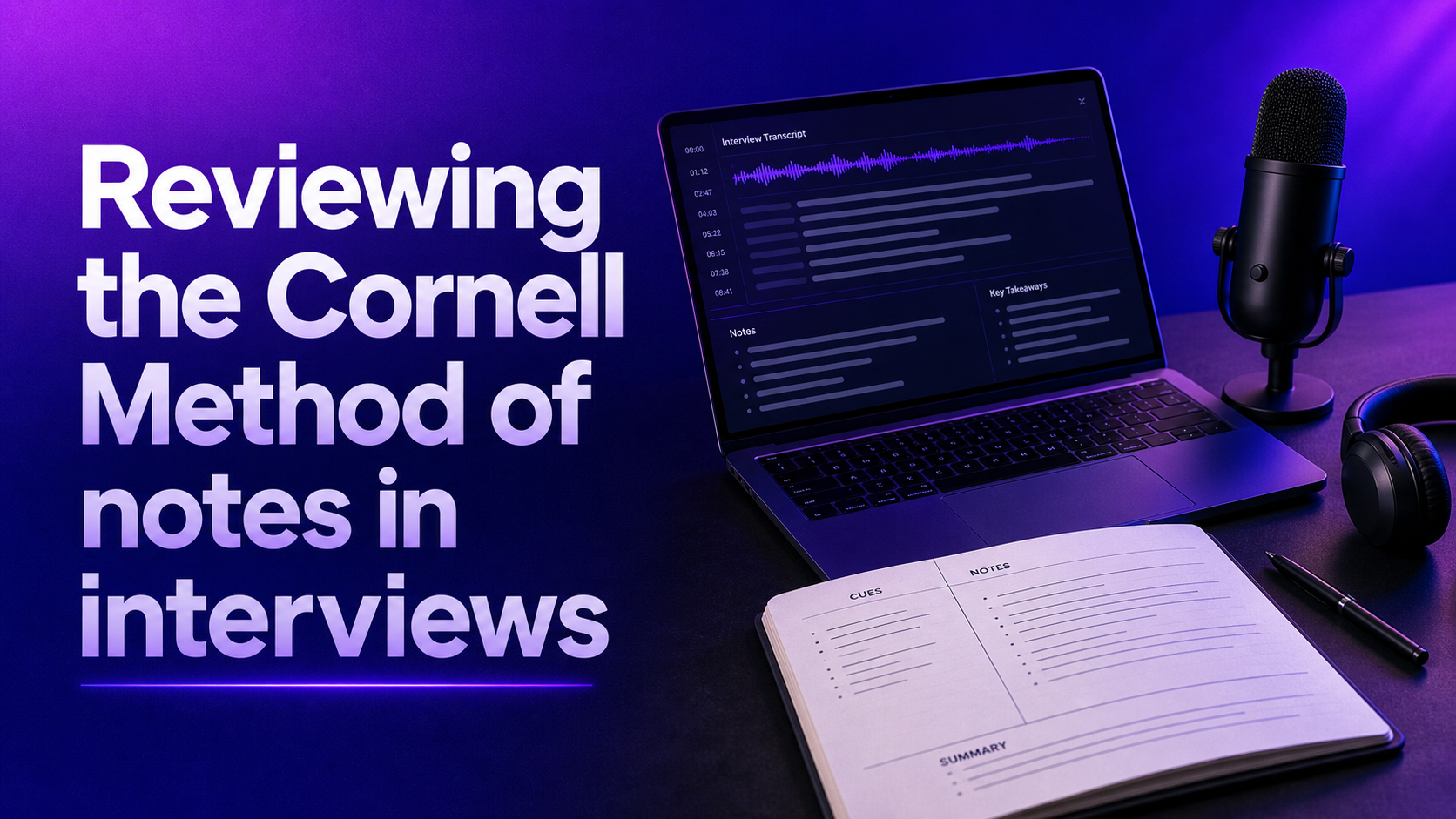



Interview transcription goes beyond simply converting audio to text, it transforms how hiring teams capture, review, and make decisions by providing a reliable, shared record that increases speed, fairness, and clarity throughout the process.
Interview transcription is often framed as a simple admin task: turn audio into text, save the file, move on. In hiring, that view is too narrow. A transcript is not just a record of what was said in an interview. It is the foundation for better notes, clearer summaries, faster debriefs, and more consistent decisions across interviewers.
For recruiters and hiring managers, the real benefit is speed with structure. Instead of relying on memory after several meetings in one day, teams can return to a searchable record, compare candidates more fairly, and extract the moments that actually matter. That changes how interview feedback is written, how hiring panels align, and how quickly decisions move forward.
The key is not transcription for its own sake. The key is using transcription well, with the right tool, the right workflow, and the right standards for accuracy.
Most interview teams still depend on some mix of handwritten notes, partial note capture in a meeting app, and memory filled in after the conversation ends. That approach creates predictable problems.
A recruiter may leave a call with strong general impressions but weak detail. A hiring manager may remember one standout answer and forget the context around it. A panel may disagree later, not because they truly interpreted the candidate differently, but because each person captured a different subset of the interview.
Interview transcription changes that dynamic.
When transcription works well, it gives teams a shared source of truth. That matters because hiring is rarely a one-person decision. It involves recruiters, hiring managers, interview panel members, and sometimes cross-functional stakeholders who need to review feedback quickly.
Here is where transcription improves hiring efficiency in practice:
This is especially valuable in high-volume hiring or multi-stage interview processes. When teams are handling many meetings every week, inefficient note capture compounds into slower time-to-hire.
There is also a quality dimension. Traditional notes tend to over-index on impressions and under-capture specifics. Good transcription creates space for evidence-based feedback. Instead of writing “strong communicator,” interviewers can point to the actual explanation the candidate gave, how they structured it, and how relevant it was to the role.
That said, transcription does not automatically improve hiring. A messy transcript that nobody reviews is just more data. Efficiency comes from moving from raw text to useful insight.
At a basic level, interview transcription converts spoken audio into written text. But in hiring workflows, the real process has several layers, especially if you want accurate records and useful outputs.
Everything starts with the interview itself. The cleaner the audio, the better the transcription result. That seems obvious, but it is often the step teams underestimate.
Common audio sources include:
Poor microphone placement, people speaking over each other, and noisy environments all reduce accuracy before the transcription tool even begins its work.
Once the interview is recorded, transcription software uses automatic speech recognition to process the audio file. Modern tools can often do this in near real time, which is why many apps now show live captions or a running transcript during a meeting.
The software breaks speech into segments, identifies likely words and phrases, and attempts to assign speakers. This is where accents, technical vocabulary, and industry-specific terms can cause errors.
In recruitment, that matters more than it does in many other business settings. Job titles, company names, product terms, and technical language can all be central to evaluation. If the transcript turns “Kubernetes” into something unreadable, the text may become less useful for review.
A transcript without speaker separation is hard to use. In an interview, context depends on knowing who asked the question and who answered it.
Most modern transcription tools attempt speaker identification automatically. Some systems simply label speakers as Speaker 1 and Speaker 2. Others integrate with meeting platforms and can identify participants by name.
For hiring teams, accurate speaker labeling matters because it affects:
Even the best AI transcription is rarely perfect. Editing is what turns a raw transcript into a reliable working document.
That does not mean cleaning every filler word. In most hiring workflows, the goal is not courtroom-level verbatim text. The goal is a readable and accurate transcript that preserves meaning.
Editing usually includes:
This step is where many teams gain a big efficiency advantage. Instead of manually writing everything from scratch, they review and refine an existing text record.
This is the stage that matters most. Once transcription is complete, teams can use it to generate summaries, extract competencies, compare answers, and update scorecards.
For example, a recruiter might move from transcript to decision-ready output like this:
That is why the real question is not only “How do I transcribe an audio file into text?” It is also “What happens after the text exists?”
In recruiting, the transcript is the raw material. The real work is interpretation.
There is no single best transcription tool for every team. The right option depends on interview volume, collaboration needs, privacy requirements, and whether you need simple notes or a more complete hiring workflow.
Some teams start with a free app. Others need advanced meeting transcription with summaries, speaker tracking, and integrations. The important point is to match the tool to the actual work.
If your team only transcribes interviews occasionally, lightweight tools may be enough. These are often attractive because they are easy to test and may offer a free plan.
Examples include:
These tools are fine when the goal is speed and convenience. They are less effective when several interviewers need to review evidence later.
Dedicated meeting transcription apps are usually a better fit for structured hiring processes. They can capture the meeting automatically, identify speakers, and generate searchable text and summaries.
Otter.ai is one of the most recognized options in this category. Many users like it because it works well for meetings, provides live notes, and makes transcripts searchable. Otter also offers collaboration features, which can help teams review conversations together. For recruiters, it is useful when interviews happen frequently and stakeholders need easy access to the record.
Microsoft 365 can also support transcription through tools such as Teams and related workflow features. This is often a strong option for organizations already using the Microsoft ecosystem. The advantage is not only transcription itself, but how easily meeting records can connect with calendars, collaboration spaces, and internal documentation.
Manual transcription still has a role, especially in sensitive or highly specialized interviews. But for most recruiting teams, fully manual work is too slow.
A practical comparison looks like this:
For a recruiter managing many interviews in one week, this hybrid model is often the most realistic plan. Let the software do the first pass, then refine the transcript and turn it into structured feedback.
The best transcription apps for hiring are not just the ones with the highest speech recognition score. They are the ones that support the full review process.
Focus on questions like:
If the answer to these questions is no, even a strong transcription engine may create more work than it saves.
Accuracy in transcription is not only about software quality. It is also about process discipline. Teams that get the most value from transcription usually follow a few simple habits consistently.
First, improve recording conditions whenever possible. Ask everyone to use a good microphone, reduce background noise, and avoid talking over one another. This has an immediate impact on transcript quality.
Second, set expectations before the interview starts. If your process includes recording or transcription, make sure participants understand it and consent where required. Beyond compliance, this creates a more transparent candidate experience.
Third, define what “accurate enough” means for your team. In hiring, a transcript does not need to capture every pause or filler word. It does need to preserve meaning, evidence, and context. That distinction saves time.
Here are practical ways to improve transcript quality:
There is also an important bias angle here. Transcripts can support fairer hiring, but only if used carefully. A transcript gives more evidence, not more objectivity by default. Teams still need structured criteria. Otherwise, they may simply use the text to justify an impression they already formed.
This is why strong interview processes combine transcription with:
When those elements work together, transcription becomes more than a convenience feature. It becomes part of a more disciplined hiring system.
Interview transcription is more than just a convenience; it transforms scattered conversations into a powerful, searchable knowledge base that can revolutionize hiring decisions. The true game-changer is not the transcription itself but how it is leveraged to distill insights, ensure fairness, and streamline the reviewing process.
Simply capturing words on paper won’t improve hiring efficiency unless those transcripts are integrated thoughtfully into the workflow. When wielded correctly, transcription becomes the secret weapon for consistency and clarity across diverse interviewers and candidates, challenging traditional memory-based evaluation methods.
Even with modern tools, interview transcription has friction points. Knowing where they show up helps teams solve them before they become workflow problems.
If the original audio is weak, the final transcript will usually be weak too. No app can fully rescue a noisy conversation with overlapping speech.
The solution is operational, not technical alone. Encourage headsets, quiet rooms, and clear turn-taking in interviews. If your team runs high-volume remote meetings, this small process change can save substantial clean-up time.
Panel interviews are especially difficult. Several interviewers may speak briefly, interrupt, or jump between follow-up questions. That creates messy speaker attribution.
A good practice is to keep introductions clear and limit cross-talk. Some teams also assign one lead interviewer to manage the flow, which improves both the candidate experience and the transcript.
Automatic summaries are useful, but they can miss what matters most in hiring. A generated summary may say a candidate showed “strong collaboration,” while the actual transcript reveals that the answer was vague and unsupported.
This is why summaries should be treated as drafts, not final judgments. They help teams move faster, but they still need human review.
A 45-minute interview can produce pages of text. If recruiters simply store transcripts without a review system, they replace one problem with another. Instead of incomplete notes, they now have information overload.
The fix is to build a lightweight workflow around the transcript:
Interview transcripts contain sensitive candidate information. Teams need a clear plan for who can access records, how long they are retained, and where they are stored.
This becomes even more important when using third-party apps, free plans, or tools that sync with broader collaboration systems. Convenience should not override governance.
For many organizations, the best approach is simple: transcribe only what serves a hiring purpose, restrict access to relevant users, and define retention policies before the process scales.
This is where interview transcription proves its value. Not at the moment the text appears on screen, but in what the hiring team does next.
A useful transcript supports three outcomes at once: better recall, better collaboration, and better decisions.
Imagine a recruiter finishes a first-round interview for a customer success role. In a traditional workflow, they might write a quick note, remember two or three standout moments, and send a brief summary to the hiring manager later that day. Important nuance can disappear in that gap.
With a stronger transcription workflow, the process looks different. The recruiter reviews the transcript shortly after the meeting, checks the candidate’s examples against the role criteria, and creates a concise summary grounded in evidence. The hiring manager then reads a sharper overview, not just a memory-based impression. If there is disagreement later, the team can return to the source record rather than debating whose notes were better.
That has several practical benefits for hiring teams:
In this sense, transcription is not separate from hiring efficiency. It is part of how efficient hiring gets built. The meeting record becomes usable data. The note becomes a structured insight. The interview becomes easier to review across teams and across time.
The strongest hiring processes do not treat transcription as the final output. They treat it as the bridge between conversation and decision. When used that way, transcription helps recruiters and hiring managers spend less time chasing details and more time making thoughtful, consistent hiring choices.
Blog