


Effective note-taking is about capturing the key ideas, decisions, and actions that drive understanding and progress, not about writing everything down. Choosing the right method, staying focused, and organizing your notes strategically transforms meetings into valuable resources.
Good notes do more than create a record. They sharpen attention, improve recall, and turn a conversation into something you can actually use later. That matters in almost every setting. In a class, notes help with learning and study. In a lecture, they make review easier. In a work meeting, they keep projects moving. In an interview, they help candidates remember key details and help recruiters evaluate people fairly.
A common mistake is thinking that more writing means better writing. It usually does not. The best notes are selective.
When you focus on the right points, your brain starts processing information instead of just storing it. That improves retention. It also saves time when you come back for review.
In real life, the value of notes changes depending on the context:
This is why note-taking should never be passive. You are not just recording information. You are deciding what matters. A useful rule is simple: if a point will affect action, understanding, or evaluation later, it belongs in your notes.
There is no single best method for every meeting. A brainstorming session, a training lecture, and a job interview all have different rhythms. Choosing the right structure helps you write faster and think more clearly.
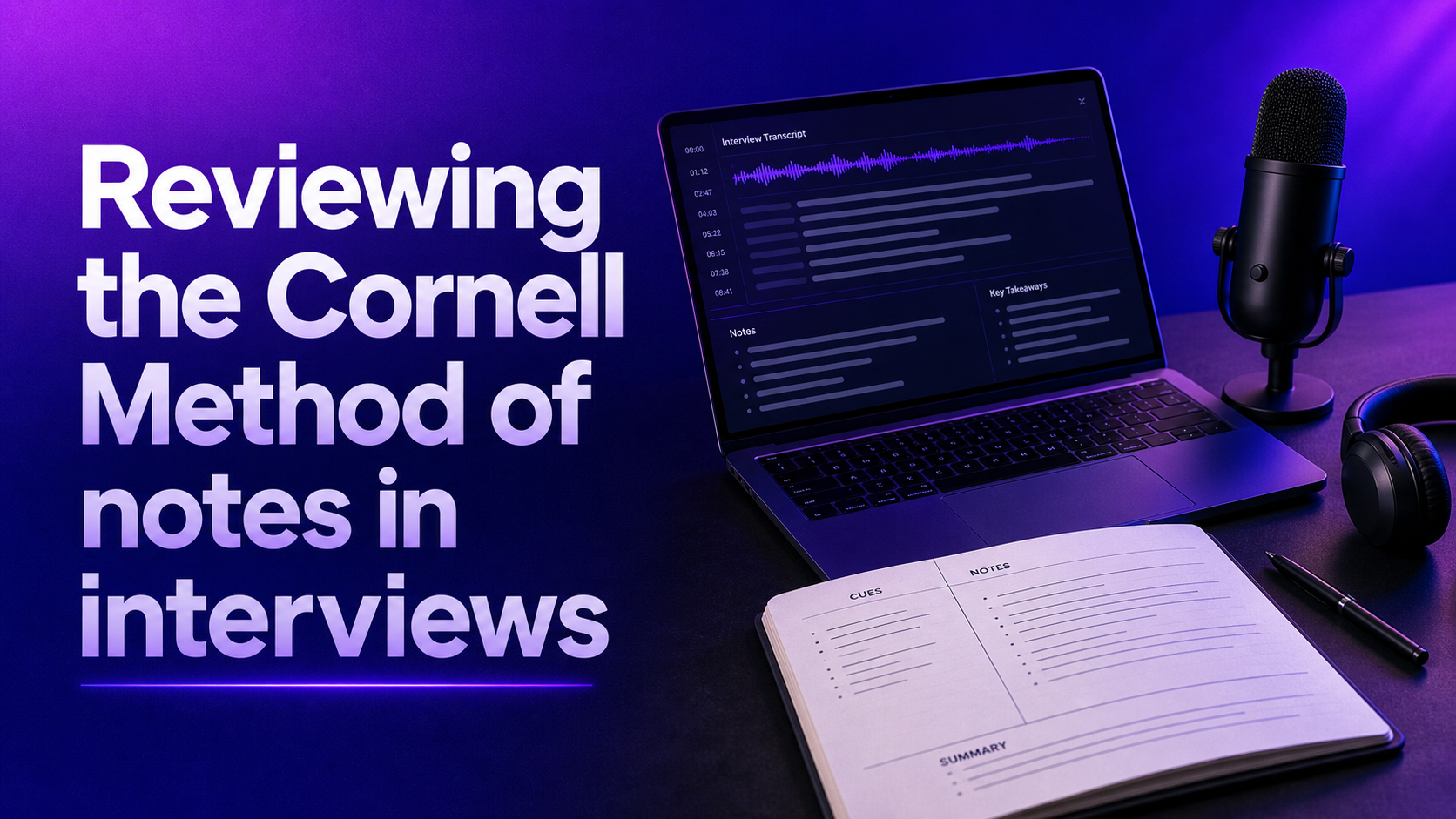
The Cornell method works well when you want both capture and reflection. Divide your page into three areas:
This method is effective for classes, lectures, and structured meetings because it makes review easier. You can write during the conversation, then summarize the key ideas in a few lines after it ends. In an interview, for example, your main section might include examples the candidate shares. The cue column can hold skill areas like communication, problem solving, or stakeholder management. The summary at the bottom becomes your first evaluation draft.
The outlining method is one of the easiest ways to take good notes when the discussion follows a clear order.
Use headings, then indent supporting details under each one. This is a strong method for agenda-led meetings, one-on-ones, and project updates.
For example:
Outlining helps you see hierarchy. You know what the main topic is, what supports it, and where decisions were made.
Mind mapping is useful when ideas connect in multiple directions. Instead of writing in straight lines, you place the main topic at the center and branch related ideas outward.
This method works well for brainstorming, strategy sessions, or learning a complex subject in class. It is especially helpful when you are trying to understand relationships rather than sequence. If a meeting jumps between themes, mapping can be more natural than forcing everything into a strict outline.
In fast business settings, you often need something more practical than a textbook format. A simple four-part structure works well:
This method is good for recruiters, hiring managers, and candidates because it keeps the note tied to future action. It also makes handovers and follow-ups much easier.
Even the best method will not help if your attention drifts. Concentration is often the hidden skill behind effective note-taking.
Most poor notes begin before the meeting even starts. If you walk in without context, every sentence feels equally important.
Take two minutes to prepare:
This small habit reduces cognitive load. Instead of reacting to information, you are ready to sort it.
People often announce important information without realizing it. Watch for phrases like:
These signals tell you what to write down. They separate the core message from the conversational filler.
In a lecture, the same principle applies. In a class, an instructor might repeat an idea, slow down, or say, “This will be on the exam.” In a meeting, a manager may stress timing, ownership, or impact. In an interview, a candidate may reveal their strongest evidence in one specific example. Your notes should reflect those moments.
Trying to write full sentences slows you down. Develop a small personal system:
The goal is speed without losing meaning. You can always expand your notes later.
One underrated tip is to leave blank space between sections. This gives you room to add points when the speaker returns to a topic.
It also makes your notes easier to review. Dense blocks of text look complete, but they are harder to scan and harder to use.
Taking notes is only half the job. The real value comes when you can return to them quickly and understand what happened. If your notes are disorganized, review becomes a second meeting with none of the context.
Try to clean up your notes within 10 to 15 minutes after the meeting. This is when your memory is strongest.
At that stage:
This habit is one of the most effective ways to improve retention. It also helps if you need to share notes with someone else.
This is especially important in interviews and hiring discussions.
A factual note says, “Candidate described leading a team of five through a product launch.”
An interpretive note says, “Strong leadership.”
Both can matter, but they should not be mixed together. When facts and opinions blend too early, bias can creep in.
The same principle helps in study and learning. In a lecture, separate what the teacher actually said from your own interpretation of it. That makes review more accurate.
Good notes should support future thinking, not just past memory.
A practical review system can be very light:
This is where note-taking becomes a strategic habit. You stop collecting information and start building continuity.
Clear and well-organized notes are not just a helpful tool; they are essential for both candidates and recruiters in navigating the interview process with fairness and precision. Candidates who diligently capture key details show genuine engagement, setting themselves apart in competitive settings.
For interviewers, structured note-taking is a safeguard against bias and forgetfulness, ensuring every candidate receives a fair evaluation based on facts rather than impressions. This disciplined approach ultimately leads to smarter hiring decisions and a more transparent recruitment process.
Technology can absolutely help, but only if it supports thinking rather than replacing it.
Different tools fit different needs:
Still, tools should not become an excuse to disengage. A transcript is not a substitute for a good note. It records everything but often highlights nothing. Human judgment is still needed to identify the main points, the meaning, and the implications.
Some mistakes show up in almost every setting:
The fix is not more effort. It is more intention.
In hiring, note quality affects fairness, speed, and confidence.
For candidates, taking notes during recruiter calls or interview processes helps them remember names, timelines, role expectations, and culture signals. It also helps them ask better follow-up questions and compare opportunities more clearly.
For interviewers and recruiters, structured note-taking creates a more reliable record of what was actually said. That matters because memory is selective. Without good notes, teams may overvalue charisma, recent impressions, or one standout moment while forgetting the evidence that should drive the decision.
Strong interview notes also make debriefs more useful. Instead of vague reactions, teams can discuss specific examples. That leads to better alignment and better hiring outcomes.
In other words, good notes are not just an administrative habit. They are part of how people learn, evaluate, and decide well under pressure.
The best note-taking method is the one that helps you stay present in the meeting, capture what matters, and return to it with clarity later. If you can do that consistently, your notes will become one of the most useful tools you have, whether you are in a class, a client meeting, or an interview room.
Blog