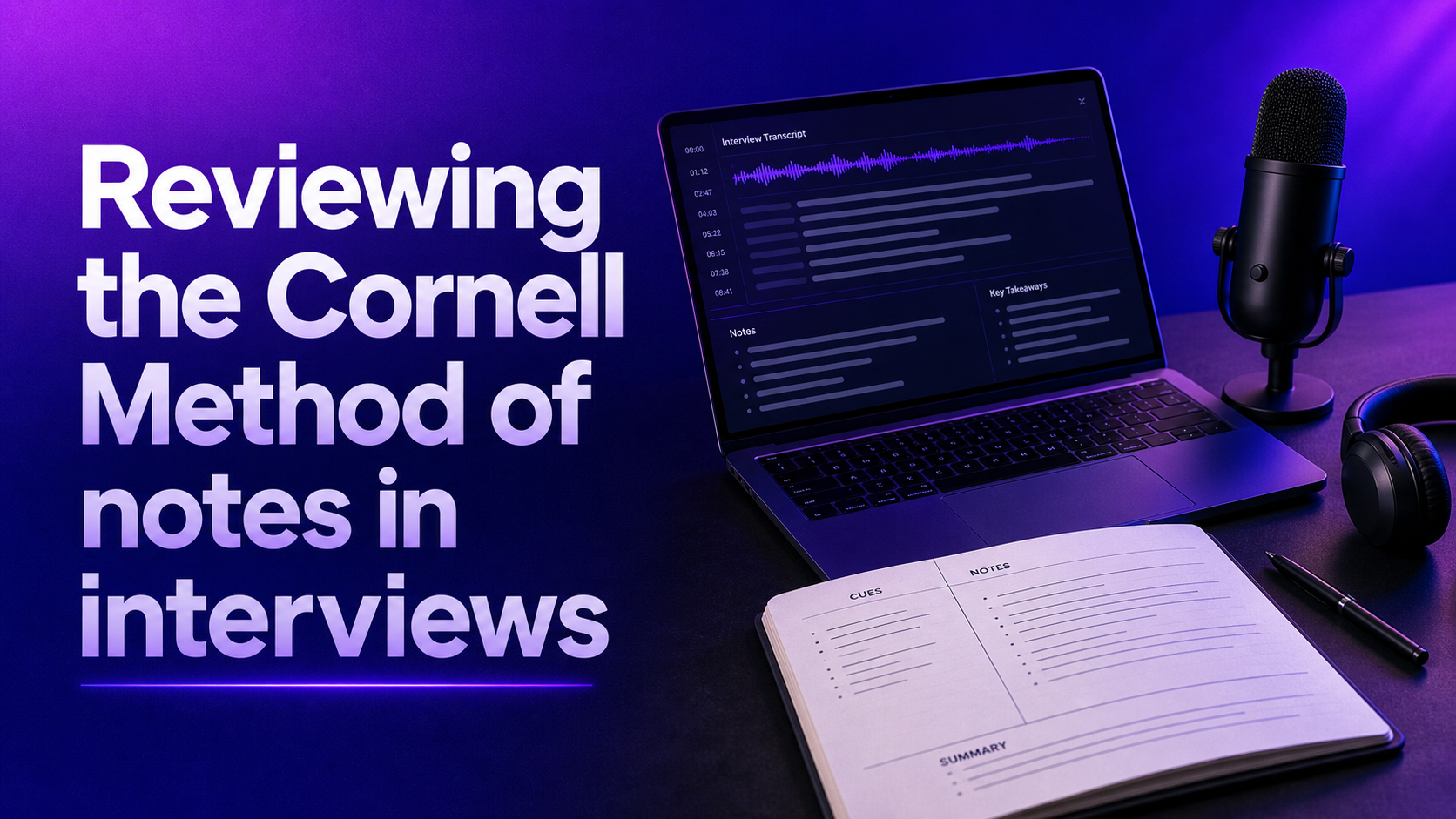



Accurate and efficient audio transcription is transforming recruiting by allowing interviewers to focus on conversations rather than note-taking, leading to better candidate evaluations and streamlined hiring workflows.
Recruiters are under growing pressure to capture more detail, move faster, and still stay fully present in every interview. That is exactly why audio transcribe tools have become so important in hiring.
A good transcription workflow does more than turn a recording into text. It helps recruiters avoid losing key information, compare candidates more fairly, and reduce the scramble of writing notes while trying to listen. When a transcript is accurate enough to show who said what, it becomes much easier to review how a candidate described their experience, how the role was presented, and what follow-up points need to be shared with the hiring team.
That said, most recruiters are not looking for another complicated app to manage. They need a tool that can record, transcribe, organize, and help update the interview document without adding friction. They also need to handle this responsibly. Candidate consent for a recording is essential and should never be skipped.
In this guide, we will look at the best transcription tools for recruiting, what affects transcription accuracy, which features actually matter, and how to choose a solution that fits real hiring workflows.
Interview quality often drops when recruiters are forced to split their attention. They are listening, asking follow-up questions, thinking about evaluation criteria, and trying to write notes at the same time. Important details can slip through the cracks very quickly.
A reliable audio transcription process changes that dynamic.
Instead of trying to capture every word in real time, the recruiter can focus on the conversation itself. After the meeting, they can review the transcript, edit key passages if needed, and create cleaner evaluation notes. That leads to better candidate comparisons and less guesswork later.
For recruiting teams, the biggest benefits are practical:
This is especially valuable in high-volume recruiting, executive search, and multi-stage interviews. In those settings, memory is rarely enough. Even very experienced recruiters forget wording, context, or who raised a particular point.
There is one non-negotiable principle here: if you plan to record an interview, candidate consent must come first. Consent should be explicit, documented, and easy to understand. That is not just a best practice for trust. In many jurisdictions, it is also a legal requirement.
Most modern transcription tools rely on automatic speech recognition, often enhanced by AI models that can identify speakers, summarize conversations, and convert spoken word into structured text. On paper, many vendors promise high accuracy. In reality, performance depends heavily on the quality of the recording and the context of the interview.
For recruiters, it helps to think of transcription accuracy as a workflow issue, not just a software claim.
A tool may perform well in a quiet one-on-one Zoom meeting, but struggle with overlapping voices, poor internet audio, strong accents, industry jargon, or in-person room noise. That matters because a transcript that gets speaker attribution wrong can distort the meaning of an answer.
Here are the biggest factors that affect accuracy:
The good news is that transcription quality has improved dramatically. For many recruiting conversations, today’s tools are more than good enough to save time and improve documentation. The key is knowing what “good enough” means in your workflow.
If you need a transcript for quick review, internal meeting notes, and candidate summaries, AI transcription can be highly effective. If you need legal-grade accuracy for a sensitive case, a human-reviewed service may still be the better option.
There is no single best transcription service for everyone. Some tools are built for general meetings, some for media editing, and some for higher-accuracy transcript delivery. Recruiters should choose based on workflow, not hype.
Here is a practical comparison of leading options.
| Tool | Best for | Key strengths | Main limitations |
|---|---|---|---|
| Otter.ai | Recruiters who want fast meeting transcription | Easy meeting capture, live notes, searchable transcript, collaboration features | Can struggle with speaker accuracy in messy audio, less hiring-specific workflow support |
| Fireflies.ai | Teams that want meeting automation across tools | Good meeting recording, summaries, integrations, useful for recurring hiring syncs | Better for general meeting intelligence than structured interview evaluation |
| Rev | Teams that need stronger accuracy options | AI transcription plus human transcription services, useful for important interviews | Human review costs more and turnaround may take longer than instant tools |
| Sonix | Recruiters handling many audio files | Fast file upload, multilingual support, useful edit interface, export flexibility | Can feel more transcription-first than workflow-first for recruiters |
| Trint | Teams that want collaborative transcript editing | Strong editing, searchable text, good for content-heavy review work | More useful for editorial workflows than recruitment operations |
| Descript | Users who want to edit audio and transcript together | Excellent for editing recording and transcript in one place | More than many recruiters need, can feel overbuilt if you only want interview documentation |
A few practical takeaways stand out.
Otter.ai is often the easiest starting point for recruiters who want to record a meeting and get searchable notes quickly. It is user-friendly, has a free tier, and works well for standard interviews. If your needs are basic, it can be a solid first app.
Fireflies.ai is attractive for teams that run many calls and want automation. It can join meetings, create summaries, and help update internal records. The tradeoff is that it is still a general-purpose meeting product, not a recruiting-first system.
Rev is worth considering when accuracy matters more than speed. If you are transcribing an especially important interview or need more confidence in the final document, the human transcription option can be valuable. The tradeoff is cost and time.
Sonix and Trint are strong if your team often uploads audio files after the fact and wants a more hands-on edit experience. They are useful for refining transcripts, but they may not solve the broader problem of fragmented hiring workflows.
Descript is powerful if you also work heavily with media, training content, or interview clips. For standard recruiting teams, though, it may be more tool than necessary.
When comparing these products, do not get won over by one advertised accuracy percentage. Look at the full workflow. Can the tool record reliably? Can it label speakers well? Can you edit the text quickly? Can you export a transcript or document easily? Can it fit into your hiring process without creating more admin?
That is where many recruiters realize they do not just need transcription. They need a system that helps turn interviews into usable hiring decisions.
The best transcription app for recruiting is not necessarily the one with the most features. It is the one that reduces work, improves recall, and helps your team act on interview information faster.
If you are evaluating options, these are the features that matter most.
In recruiting, a transcript without reliable speaker labels can create confusion. You need to know what the candidate said about their current role versus what the recruiter said about the job opening. If those lines blur, review quality drops.
Look for tools that clearly separate speakers and let you correct labels easily.
Even strong AI transcription usually needs a light edit. The app should make that fast. You should be able to correct names, fix wording, and highlight important passages without wrestling with the interface.
This matters even more when you are working through several interviews in a short time.
Export options and document flexibility
A good tool should let you move the transcript into the format your team needs. That could mean plain text, a Word document, subtitles, or structured meeting notes. Some teams want a full verbatim record. Others want a concise summary with timestamps.
The more flexible the file export, the easier it is to fit transcription into your current process.
This is where recruiters often hit friction. If the transcript lives in one app, notes in another, scorecards in a third, and the ATS update somewhere else, the admin burden stays high.
A better setup connects transcription to the rest of the hiring workflow:
This is also why a general transcription tool is not always enough for recruiting teams at scale.
Search, summaries, and retrieval
As your interview volume grows, retrieval becomes just as important as recording. You need to be able to search across transcripts, jump to key moments, and quickly find the evidence behind a hiring decision.
AI summaries can help here, but only if they are grounded in a trustworthy transcript.
Many tools offer a free plan, but limits can appear quickly through storage caps, monthly minute allowances, or reduced export options. Before committing to a subscription, check:
For occasional use, a free option may be enough. For recruiting teams running daily interviews, it is worth paying for reliability and workflow fit.
Transcribing interviews is no longer just a convenience; it is essential to prevent critical details from slipping through the cracks and to enable a more focused, engaged hiring process. When recruiters can review precise, speaker-identified transcripts, they gain a powerful tool for comparing candidates and verifying key points without juggling multiple complex systems.
Yet, this process must respect the candidate’s consent and remain accessible to non-technical users to truly enhance recruitment. Quality transcription bridges the gap between conversation and data, transforming interviews from fleeting moments into reliable, actionable insights, making it a game-changer worth mastering.
The strongest use case for transcription in recruiting is simple: it helps teams make better decisions with less manual effort. But the value shows up differently depending on the stage of the process.
During early screening calls, transcription helps recruiters capture background, compensation expectations, motivation, and availability without relying on fragmented notes. This saves time and supports cleaner handoffs.
In structured interviews, transcripts become useful comparison tools. If several candidates answer the same competency question, the team can review patterns more objectively. That reduces the risk of relying too heavily on memory or interview bias.
For hiring manager syncs and panel interviews, a shared transcript helps align everyone on what was said. It also reduces the common problem of incomplete or delayed feedback after a meeting.
Transcription can also help with candidate experience. When recruiters are not busy taking notes, the conversation feels more attentive and natural. That can make a meaningful difference in competitive hiring markets.
Still, the benefits only hold if the process is handled responsibly.
Before you record or transcribe any interview, make sure the candidate knows that the meeting will be recorded, how the recording and transcript will be used, who will have access, and how long the data will be retained.
This should be communicated clearly and professionally. A vague line buried in a calendar invite is not enough.
Recruitment conversations often contain sensitive personal data. That means your transcription service should be evaluated like any other system that handles candidate information.
Review the basics carefully:
If your team hires across regions, you should also check any relevant privacy regulations that apply to candidate data.
Not every interview needs to live forever as a recording. Define how long files will be kept, who can view them, and when they should be deleted. A transcript should support the hiring process, not create unnecessary data risk.
The best practice is to keep only what is useful, restrict access, and make governance part of the workflow from the start.
Standalone transcription tools are helpful, but many recruiting teams eventually hit the same wall. They can record the meeting and generate a transcript, yet the real work still happens elsewhere.
Someone still has to turn the text into structured notes. Someone still has to compare answers against the role criteria. Someone still has to update the ATS, chase scorecards, and summarize feedback for the hiring manager.
That is where a recruiting-specific solution becomes much more valuable.
Liroad is relevant here because it goes beyond simple audio transcription. It is designed for interview and hiring workflows, not just meeting capture. Instead of asking recruiters to juggle multiple tools, Liroad helps centralize interview information, reduce manual admin, and turn conversations into structured hiring data.
For teams that want more than a basic transcript, that means practical advantages:
If your main need is occasional transcription of a single audio file, a lightweight tool may be enough. But if your team runs interviews continuously and wants better documentation, better comparisons, and less administrative drag, it makes sense to look at a platform built around recruiting operations.
The bottom line is simple: transcription is no longer a nice-to-have in hiring. It is becoming a core part of how modern teams record, review, and act on interview information. The best choice is the one that gives you accurate enough transcripts, protects candidate trust, and fits naturally into the way your team hires. For many recruitment teams, that means looking beyond generic meeting apps and toward a solution like Liroad that helps the whole process move faster and more reliably.
Transcription helps recruiters focus on the conversation instead of note-taking, improves candidate comparisons, aligns hiring teams, reduces administrative work after interviews, and strengthens process discipline, especially in high-volume or multi-stage interviews.
Key factors include audio quality, speaker separation, context and vocabulary understanding, the need for post-call editing, and the desired output format. Clear recordings and proper speaker identification are particularly important.
Essential features include reliable speaker identification, easy review and editing workflows, flexible export options, good integrations with other hiring tools, search and summarization capabilities, and transparent pricing suited to your volume of use.
Candidates must be informed explicitly about recording and transcription, how their data will be used, who can access it, and data retention policies. Data security measures like encryption and controlled access are also critical when selecting a vendor.
Blog